
SIMILAR IMAGES


IMAGE INFORMATION
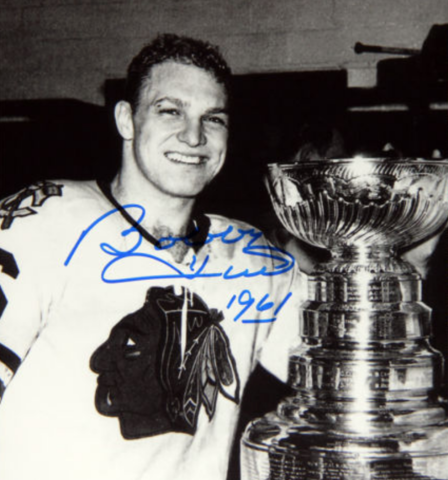
EditRobert Marvin "Bobby" Hull, OC - Born January 3, 1939 in Point Anne, Ontario - Died January 30, 2023 in Wheaton, Illinois was a Canadian/American ice Hockey left winger and coach.
- Sutherland Cup Champion 1955 with Woodstock Warriors.
- Stanley Cup Champion 1961 with Chicago Black Hawks.
Stanley Cup finalist 1962, 1965, 1971.
- Prince of Wales Trophy Champion 1967, 1970 with Chicago Black Hawks.
- Art Ross Trophy Winner 1960, 1962, 1966 with Chicago Black Hawks.
- Hart Memorial Trophy Winner 1965, 1966
- Lady Byng Memorial Trophy Winner 1965
- Lester Patrick Trophy Winner 1969
- Avco World Trophy / Avco Cup Champion 1976, 1978, 1979 with Winnipeg Jets.
Avco Cup finalist 1973, 1977.
- Gary L. Davidson Award (Gordie Howe Trophy) Winner 1973, 1975 with Winnipeg Jets.
- 1976 Canada Cup Champion with Team Canada.
- Wayne Gretzky International Award 2003
"His blonde good looks and sparkling charisma combined with his on ice speed and swagger earned him the nickname "The Golden Jet." Oddly enough, Hull would become a Jet when he signed with Winnipeg of the WHA"
Hull played his minor Hockey in Belleville, and then Jr. "B" Hockey for the Woodstock Warriors in the fall of 1954. Although the Sarnia Legionnaires and the Waterloo Siskins were the Jr. "B" powerhouses of the 1950s, Hull threw a wrench into their domination, leading the Warriors to the 1955 Sutherland Cup as all-Ontario champions.
Hull was signed by the Chicago Black Hawks organization, and as a 15-year-old, he played a handful of games with the Galt Black Hawks of the OHA and didn't look out of place.
The Black Hawks next moved Hull up to the main junior affiliate, the OHA's St. Catharines Teepees. During his second year, in 1956-57, Hull scored 16 points in 13 playoff matches for the Teepees, leading them to the finals of the J. Ross Robertson Cup Junior. A few months later, he put two pucks past New York Rangers goalie Gump Worsley in a pre-season game to launch one of the greatest of NHL careers.
Hull's highly anticipated regular season NHL debut came on October 8, 1957 vs Toronto Maple Leafs at Chicago Stadium in a 1-0 Black Hawks win.
Hull scored his 1st NHL goal vs Don Simmons of the Boston Bruins at 16:00 of 1st period on on October 22, 1957 at Chicago Stadium in a 2-1 Black Hawks win.
Hull didn't disappoint the Black Hawks' fans and ownership, as he turned in a fine 13 goal and 47-point effort that year to finish runner-up to Toronto's Frank Mahovlich in the Calder Trophy voting at the end of the season.
Hull improved to 18 goals and 50 points in his sophomore year before breaking out in 1959-60 with a league-high 39 goals and 81 points. Hull scored his 1st NHL hat-trick vs Harry Lumley of Boston Bruins on December 6, 1959 at Boston Garden in a 6-3 Black Hawks win. Teamed with Bill Hay and Murray Balfour on the Million Dollar Line, Hull won the Art Ross Trophy and earned a place on the NHL First All-Star Team.
Hull married former figure skater, Joanne McKay, in 1960. Together they had five children, Bobby Jr., Blake, Brett (who later had a stellar NHL career of his own), Bart, and Michelle.
Hull originally wore numbers 16 and 7 as a Black Hawk but later switched to his famous number 9, a tribute to his childhood idol Gordie Howe.
Together with teammate Mikita, Hull developed the curved Hockey stick, which gave the shooter more velocity and caused the puck to move differently at times. And what goalies throughout the league didn't need was the most feared shot in the NHL behaving like a curve ball.
The 1960-61 regular season was somewhat of a letdown for Hull individually, but in the playoffs he scored 4 goals and 14 points in 12 games as Chicago won the Stanley Cup for the first time since 1938. Hull, in his first Stanley Cup Finals, scored 2 goals in Game One, including the game-winner.
Bobby Hull joined the 50 goal club on March 25, 1962 when he scored his 50th goal vs Gump Worsley of New York rangers at 4:58 of 1st period at Madison Square Garden in a 4-1 Rangers win. It was the final game of the season. Hull would win the Art Ross Trophy this season.
Hull was one of the fastest skaters in the NHL, clocked at 29.7 miles per hour without puck and 28.3 with it. Though his slapshot was his fastest shot, clocked at 118.3 mph, Hull's wrist shot was timed at 105 mph while his backhand was at 96 mph. Hull was also entertaining on the ice, much to the delight of Chicago fans. Joe Sexton of The New York Times wrote, "Bobby Hull was a swift-skating left wing who manufactured goals with his sheer mania for work, as well as his volcanic blast of a slap shot. And if he lost the majority of his teeth plowing through defenses, he never lost face."
On March 12, 1966, he became the first NHL player to score more than 50 goals in a season, surpassing Maurice Richard's and Bernie Geoffrion's hallowed mark of 50 goals. His 51st goal was scored against Cesare Maniago of New York Rangers at 5:34 of 3rd period at Chicago Stadium in a 4-2 Black Hawks win. Hull received a seven-minute standing ovation from the Chicago Stadium faithful after he scored. Hull eventually scored 54 goals that season, the highest single season total of the Original Six era. Hull would win the Art Ross Trophy and the Hart Trophy this season.
In 1966-67, Hull's 52 goals helped Chicago win its first regular-season championship (Prince of Wales Trophy) since coach Pete Muldoon cursed the team after he was fired in 1938. They lost in playoff semifinals to Toronto Maple Leafs.
Hull scored 44 goals during the first expansion season, then followed up with a record-breaking performance in 1968-69. His 58 goals set a single-season record that fans thought would last many years. As it turned out, Boston's Phil Esposito hit the back of the net 76 times two years later. In January 1970, Hull was named by the Associated Press as the top NHL player of the 1960s.
While Esposito was leading the Bruins through a magical regular season in 1970-71, the Black Hawks were led by Hull's 44 goals and finished first in NHL West Division.
On February 14, 1971, he scored twice against the Vancouver Canucks to surpass Maurice Richard for second place on the NHL's all-time goal-scoring list. Hull then embarked on the most productive post-season of his career with 11 goals and 25 points in 18 games as Chicago came within one period + of winning the Stanley Cup. Hull had assisted on the 1st goal, and Chicago was Leading 2-1 late in the second period of game 7, the Black Hawks couldn't hold the lead and lost 3-2 in front of a disappointed home crowd.
In 1971-72, Hull hit the 50-goal mark for the fifth time in his career, playing with Pit Martin and Chico Maki. At this stage of his career, many observers noted that he was playing his most well-rounded Hockey ever. Ironically, this complete version of Bobby Hull was the last NHL fans would see of him for several years.
Long unhappy because of his relatively poor salary in the period when he was Hockey's preeminent superstar, Hull responded to overtures from the upstart World Hockey Association's Winnipeg Jets in 1972 by jesting that he would jump to them for a million dollars, a sum then considered absurd. Gathering the other league owners together to contribute to the unprecedented amount on the grounds that inking such a major star gave instant credibility to the new rival league that was competing directly against the entrenched NHL, Jets' owner Ben Hatskin agreed to the sum, and signed Hull as a player/coach for a contract worth $1.75 million over 10 years plus a $1 million signing bonus.
Hull became Hockey's 1st millionaire.
Although his debut with Winnipeg was held up in litigation by the NHL, Hull instantly became the WHA's greatest star, and with Swedish linemates Anders Hedberg and Ulf Nilsson formed one of the most formidable forward lines of the 1970s known as "The Hot Line", leading the Jets to two Avco World Trophy / AVCO Cups during his time with the club. His best performance was during the 1974-75 season, when he scored 77 goals to set a new professional mark.
Hull's WHA contract had a secondary effect, causing a massive increase in players' salaries in both the WHA and NHL. In addition, the NHL spent millions fighting the very existence of the WHA in court.
Because he joined the rival league, the NHL was bitter and exacted revenge on the Golden Jet by blocking his participation to represent Team Canada in the 1972 Summit Series, which pitted Canada's top NHL players against the USSR's national team. The Prime Minister of Canada Pierre Trudeau even got involved by writing to Hockey Canada asking that in the "Best Interests of Canada" Hull be included on the team. Hull never got to play in the Summit Series.
The 1974 Summit Series was the second of two competitions between Soviet and Canadian professional ice hockey players. Canada was represented by World Hockey Association players instead of National Hockey League players, as it had been in the 1972 Summit Series. The Soviet team won the series 4-1-3 over Canada. The format was the same as the 1972 Summit Series, with four games across Canada and four in Moscow. Canada's lone victory came at Maple Leaf Gardens in Toronto. The 1974 series was an opportunity for Hull to play for Canada against the Soviet team, where he scored 7 goals and 2 assists in the series.
Prior to the 1976-77 WHA season, Hull was allowed to compete for his country in the inaugural Canada Cup tournament. He was Canada's top-scoring forward with 5 goals and consistently dished out punishing yet clean bodychecks. If this tournament was the highlight of Bobby Orr's career, it was also unquestionably Hull's one chance to shine in a competition featuring the top players from around the globe.
In the 1977-78 season, Hull played in 77 games, and scored 46 goals and 71 assists.
The WHA could not sustain itself, and several teams, including the Winnipeg Jets, folded into the NHL / WHA merger at the beginning of the 1979-80 season. Hull remained with the team, but played in only 18 games before being traded to another old WHA team, the Hartford Whalers. Hull appeared in nine regular season games, and three post-season tilts, before being released. At the time, Hull had been going through a very bitter and public divorce from his wife, Joanne. Among other claims, Joanne Hull accused him of being physically abusive. After the divorce was finalized in June 1980, she took the children and moved to Vancouver. Hull did not see his children for a decade. His personal life in shambles, Hull tried to restart his Hockey career, and in September 1981, Hull attempted one final comeback with the New York Rangers at age 42. However, it was a very brief attempt that only lasted five exhibition games before Hull and the Rangers both decided it was best to end the comeback. Hull had one goal, and one assist in those five games.
Hull played in 1063 regular season NHL games, scoring 610 goals (98 GWG), 560 assists with 634 penalty minutes, and 119 NHL playoff games, scoring 62 goals (11 GWG / 1 OTG), 67 assists with 102 penalty minutes.
Hull was selected to the NHL First All-Star Team at Left Wing in 1960, 1962, 1964, 1965, 1966, 1967, 1968, 1969, 1970, 1972. NHL Second All-Star Team Left Wing (1963 and 1971).
Hull played in NHL All-Star Games 1960, 1961, 1962, 1963, 1964, 1965,1967, 1968, 1969, 1970, 1971, 1972.
Hull was the NHL All-Star Game MVP in 1970 and 1971.
Hull played in 411 regular season WHA games, scoring 303 goals, 335 assists with 183 penalty minutes and 60 WHA playoff games, scoring 43 goals, 37 assists with 38 penalty minutes.
2nd in WHA history in goals, 6th in assists and 3rd in points.
Hull was selected to the WHA First All-Star Team in 1973, 1974, 1975. WHA Second All-Star Team 1976 and 1978.
Hull's No. 9 jersey has been retired both by the Blackhawks and the Jets.
Hull's third youngest son, Brett Hull (the "Golden Brett"), was a more glittering star yet, finishing his own illustrious career with the third-highest goal total in NHL history. Bobby and Brett are the only father-and-son tandem to achieve the marks of more than 50 goals in a NHL season and more than 600 NHL goals. They are also the only father-and-son tandem to win the Hart Trophy and Lady Byng Trophy. While playing for the Phoenix Coyotes (formerly the Winnipeg Jets) in 2005, Brett donned his father's retired No. 9 for the last five games of his career.
In 1998, Hull was ranked number 8 on The Hockey News' list of the 100 Greatest Hockey Players, the highest-ranking left winger.
In 1978, Hull was made an Officer of the Order of Canada.
Bobby Hull was Inducted into the Hockey Hall of Fame in 1983
Robert "Bobby" Marvin Hull was inducted into the Manitoba Sports Hall of Fame and Museum in 1989.
Robert Marvin (Bobby) Hull is a “Honoured Member” of the Manitoba Hockey Hall of Fame, inducted in 1992.
Bobby Hull is a Honoured member of the Ontario Sports Hall of Fame, inducted in 1997.
Hull was an Inaugural member of the World Hockey Association Hall of Fame in 2010
In January, 2017, Hull was part of the first group of players to be named one of the '100 Greatest NHL Players' in history
In 2011, statues of Bobby Hull and Stan Mikita were installed outside the United Center, where the Blackhawks currently play.