
SIMILAR IMAGES


IMAGE INFORMATION
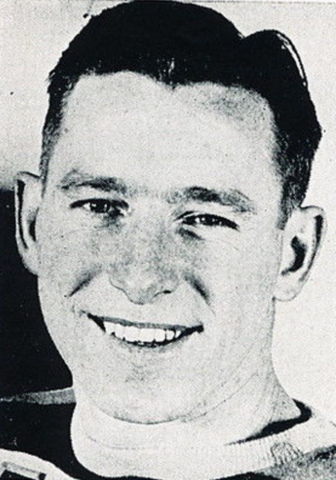
EditMilton Conrad "Milt" Schmidt - Born March 5, 1918 in KItchener, Ontario - Died January 4th 2017 in Westwood, Massachusetts was a Canadian/American ice Hockey centre, coach and general manager.
- Prince of Wales Trophy Champion 1938, 1939, 1940, 1941, 1971 & 1972 (general manager) with Boston Bruins.
- Stanley Cup Champion 1939, 1941, 1970 & 1972 (general manager) with Boston Bruins.
Stanley Cup finalist 1943, 1946, 1953, 1957, 1958.
- Allan Cup Champion 1942 with RCAF Flyers.
- O'Brien Trophy Champion 1943, 1946 with Boston Bruins.
- Hart Memorial Trophy Winner 1951 with Boston Bruins.
- Lester Patrick Trophy Recipient 1996.
Schmidt played junior Hockey with the Kitchener Empires and Kitchener Greenshirts, and in the 1934-35 season, lead the OHA with 20 goals, while teammate Woody Dumart was the OHA's points leader with 28, and he got to play with Bauer during his last year of junior
.
Schmidt was childhood friends of fellow Hall of Famers Woody Dumart and Bobby Bauer, and soon, the 3 of them would be know in Boston, and the NHL, as The Kraut Line.
Schmidt eventually signed with Boston in October, 1935, and Art Ross put Schmidt, Dumart and Bauer together and sent them down to the Providence Reds. The Reds were Boston's American Hockey League affiliate at that time. "Albert Leduc was the coach down there," remembers Schmidt. 'Battleship' Leduc had been a warrior for the Montreal Canadiens between 1925 and 1933. "He was the one who gave us the name, the 'Kraut Line.' He said, 'All you fellas come from Kitchener/Waterloo. There's a lot of people of German descent from there. We gotta get a name for ya - the Kraut Line!' We didn't mind. It was a name that kinda stuck to us."
In 1936, Schmidt and Dumart were recalled by the Bruins with Schmidt making his NHL debut on December 8, 1936 vs Detroit Red Wings at Boston Garden in a 4-3 Red Wings win.
Schmidt scored his 1st NHL goal vs Mike Karakas of Chicago Black Hawks at 6:55 of 2nd period on March 11, 1937 at Chicago Stadium in a 6-2 Bruins win. he had 2 goals in the game, his 2nd goal was the game winner.
It wasn't until the last game of that season (March 21) that Bauer was brought up, and they combined to score (Woody Dumart) their 1st goal as a line just 8 minutes into the game.
The famous Kraut Line, and were a strong and dependable line for the Bruins for most of the following 15 seasons. They were a key ingredient to the Bruins' success as they rampaged to the regular season title and a hard fought Stanley Cup victory in 1939.
The next season, the Bruins again had a 1st place finish and the 3rd most goals in team history to date.. Milt Schmidt and his linemates contributed significantly to the Bruins' successful season. Schmidt was the NHL's scoring leader in 1939-40, collecting 52 points (22 goals), while Dumart and Bauer finished 2nd and 3rd in scoring with 43 points each. "There are several reasons why we had success that year," divulges the modest Schmidt. "The 3 of us roomed together in Brookline, Massachusetts. We had one big room, so that we were always together. After practices, we discussed things that we should work on. After a game, we'd say. 'Well, we did this wrong or did that wrong.' There was no nightlife or anything like that. We were all just children, you might say. I was the youngest of the three," Milt mentions. "We really worked at it and I think that had more to do with the success of our line than anything else. To finish 1-2-3; I don't know of any other line that did that before us and we were quite proud of the fact. Hard work - that was it."
The 1941 season saw Schmidt spearhead the Bruins to their 2nd Stanley Cup championship in 3 years. However, the powerhouse Brown and Gold were decimated by World War II the following year as Schmidt, Bauer and Dumart enlisted in the Royal Canadian Air Force and superstar American goaltender Frank Brimsek enlisted with the United States Coast Guard.
Schmidt always maintained that the night of February 10, 1942, was his biggest thrill in Hockey. "That was the last game Bobby Bauer, Pork Dumart and I played before going into the service," he explained. "It was against the Canadiens, and we beat them badly (8-1). I don't think I'll ever forget what happened after the game. The players on both teams lifted the 3 of us on their shoulders and carried us off the ice and the crowd gave us an ovation. A man couldn't ever forget a thing like that."
"It just goes to show that you can have pretty bitter enemies out on that ice, but after the game is over, we're all friends, and I think that has a lot to say about the people who play the game."
The Kraut Line joined the Ottawa RCAF in time for the Allan Cup playoffs in 1942 and dominated the series. Bauer collected 22 points, Dumart 35 and Schmidt 34 points, leading the team to the Allan Cup championship before heading overseas. Schmidt, Bauer and Dumart would end up missing 3 1/2 NHL seasons, in the height of their careers due to their service in the War.
They wouldn't return to the NHL until 1945-46. "We weren't too successful when we came back after being away from it for 3 1/2 years. When we went into the service, there was no red line, but when we got back, they had introduced the red line. We had a tough time adjusting ourselves to that." The red line was adopted prior to the 1943-44 season, and was intended to speed up the game and reduce offsides. "It was by far and away a different Hockey game," muses Schmidt. "It didn't take us long to catch on and once we got our sea legs, we didn't do too badly after that."
Schmidt resumed his starring ways and finished 4th in league scoring in 1947. Named Bruins Captain in 1951, with Schmidt winning the Hart Trophy as the league's most valuable player that season.
The Kraut Line disintegrated when Bobby Bauer retired following the 1946-47 season, but for one glorious night, the line was reunited March 18, 1952 in a special tribute night. Bauer had retired in 1947 to manage his father-in-law's skate business, but when he heard his friends Dumart and Schmidt were being honoured, he agreed to take part in the festivities somehow. In pre-game ceremonies, NHL president Clarence Campbell presented the 3 with gold watches, silver services and assorted other gifts of thanks. During the game, Schmidt scored his 200th career goal, while Bauer, who hadn't played an NHL game in 5 years, recorded a goal and an assist. making the evening all the more precious to the Krauts.
Just before Christmas Day in 1954, the playing career of Milt Schmidt came to a conclusion. "I had two bad knees at that time and I had to be taped up every day or I couldn't play. When I fell, I had a tough time getting up. I was 36 years of age. We were up in Chicago, and stayed over that night. The next morning, I walked to the train station with Lynn Patrick who was coaching at that particular time. I said, 'Lynn, I don't know how much longer I can last with these knees. As a matter of fact, what would your thoughts be about me retiring?' He said, 'Milt, I know what you've been going through. You make up your own mind about retiring. I wouldn't blame you one bit if you did.' He said he'd talk with Walter Brown, who was the Bruins' president, and said, 'You'll probably be the next coach.' I had no previous experience at all, but that's how I became the coach," Schmidt explains.
Schmidt coached the Bruins up to the 1966 season with a year and a half hiatus, when Phil Watson was hired to replace the Hall of Famer. But Watson lasted slightly more than 1 season before Schmidt was back behind the bench. Schmidt also was Boston's assistant general manager. After coaching the Bruins for 11 seasons Schmidt was promoted to the general manager position in 1967 just as the league ushered in 6 new franchises, doubling in size. Schmidt proved to be a great architect in the new era of the NHL, acquiring and drafting several key players to build a Bruins team that won 2 more Stanley Cups titles in 1970, 1972. His biggest deal was a blockbuster as he acquired youngsters Phil Esposito, Ken Hodge and Fred Stanfield from the Chicago Black Hawks in exchange for journeymen Pit Martin, Gilles Marotte and Jack Norris.
After his long and loyal career in the Bruins organization, Schmidt left the team to become the 1st General Manager of the expansion Washington Capitals for the start of the 1975 season. Unfortunately for Schmidt, the Capitals set a benchmark in futility that still stands as an NHL record today, as the new franchise finished the year with a minuscule 21 points with the worst record in the 18 team league (8 wins - 67 losses -5 ties).
Milt Schmidt was selected to the NHL's First All-Star Team three times through his illustrious career (1940, 1947 and 1951) and was a Second All-Star once (1952). He finished top 10 in scoring on 5 occasions, including 1950-51 when he was awarded the Hart Trophy, emblematic of the NHL's most valuable player.
Schmidt played in NHL All-Star Games 1947, 1948, 1951, 1952.
Schmidt played in 776 regular season NHL games, scoring 229 goals (35 GWG / 4 OTG), 346 assists with 466 penalty minutes and 86 NHL playoff games, scoring 24 goals (4 GWG), 25 assists with 64 penalty minutes.
Schmidt's jersey #15 jersey number was retired by the Boston Bruins on March 13, 1980.
In January 2017, Schmidt was part of the first group of players to be named one of the '100 Greatest NHL Players' in history.
Milt Schmidt was inducted into the Hockey Hall of Fame in 1961.
Milt Schmidt was inducted into the Canada Sports Hall of Fame in 1975.
Milt Schmidt was inducted into the Massachusetts Hockey Hall of Fame in 2008.
NOTE
Milt Schmidt is the only man in the history of the Boston Bruins to have his name on the Stanley Cup 4 times.