
SIMILAR IMAGES


IMAGE INFORMATION
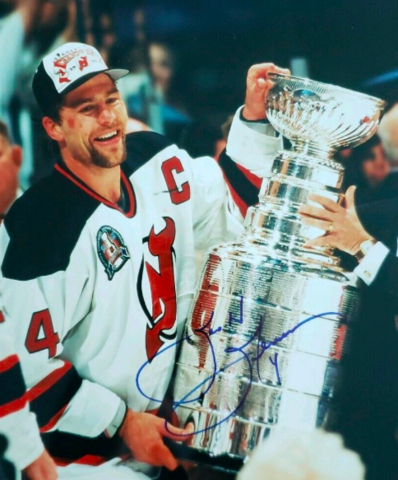
EditRonald Scott "Captain Crunch" Stevens - Born April 1, 1964 in Kitchener, Ontario is a Canadian retired ice Hockey defenceman and coach.
Stevens played in the 1976 Quebec International Pee-Wee Hockey Tournament with a minor ice Hockey team from Kitchener.
- J. Ross Robertson Cup Junior Champion 1982 with Kitchener Rangers.
- Memorial Cup Champion 1982 with Kitchener Rangers.
- 1983 Ice Hockey World Championships Bronze Medal Winner with Team Canada.
- 1985, 1989 Ice Hockey World Championships Silver Medal Winner with Team Canada.
- 1991 Canada Cup Champion with Team Canada.
- World Cup of Hockey 1996 Runner-up with Team Canada.
- Prince of Wales Trophy Champion 1995, 2000, 2001, 2003 with New Jersey Devils.
- Stanley Cup Champion 1995, 2000, 2003 with New Jersey Devils.
Stanley Cup finalist 2001.
- Conn Smythe Trophy Winner 2000.
Stevens was drafted 5th overall in the 1982 NHL entry draft by Washington Capitals.
Stevens made his NHL debut with the Capitals on October 6, 1982 vs New York Rangers, also scoring his 1st NHL goal (his 1st shot on goal) on Eddie Mio at 14:13 of 2nd period at at Madison Square Garden in a 5-4 Washington win.
After 8 seasons in Washington, Stevens felt it was time to move on, and he became a restricted free agent and was signed by St. Louis Blues on July 16, 1990, becoming the highest-paid defenceman in the NHL at that point. Washington had the option to match the offer sheet. However, they declined and consequently received 2 first-round draft picks plus $100,000 in cash. Stevens was named Blues captain and played a full season in St. Louis.
In the offseason following the 1990–91 NHL season, the Blues signed Brendan Shanahan from the New Jersey Devils, who was a restricted free agent, and the Blues and Devils could not agree on what the compensation was; the Blues offered goalie Curtis Joseph, forward Rod Brind'Amour, and two draft picks, but the Devils only wanted Stevens. The case went to arbitration, and arbitrator Edward Houston awarded Stevens to the Devils as compensation on September 3, 1991.
Stevens was reluctant to join New Jersey at first, but eventually he would report to the Devils. He was named team captain in 1992.
While playing for New Jersey, Stevens developed into one of the hardest hitting defencemen in NHL history. Mostly clean legal hits, using his shoulders for impact, a devastating open-ice hitter.
Opposition players had to be aware all the time when he was on the ice. He leveled players with open-ice body checks, featuring iconic hits on Slava Kozloz, Eric Lindros, Ron Francis, Paul Kariya and many more.... look up on Youtube Scott Stevens Biggest Hits and see for yourself.
The turning point in Stevens' career came after Jacques Lemaire took over as the Devils coach and brought Larry Robinson with him as an assistant in 1993. Stevens later said that after 12 years in the NHL, he learned more that first year with them when they came in, then the previous years playing, A lot of positioning with the stick. It was just little simple things, but they all added up and when you add those little things up they become big things that make the game much easier.
Lemaire and Robinson had more success than Stevens' previous coaches in getting him to control his temper, and his penalty minutes would go down for the remainder of his career.
The "Stevens Effect": Because his style heavily targeted the head/brain area of opposing players during a time without strict headshot laws, the transition to modern player safety regulations effectively outlawed the physical approach he mastered. NHL Rule 48, regarding illegal checks to the head would be brought in and later modified.
Stevens played in 1635 regular season NHL games, scoring 196 goals (34 GWG / 3 OTG), 712 assists with 2785 penalty minutes and 233 NHL playoff games, scoring 26 goals (8 GWG), 92 assists with 402 penalty minutes.
Stevens played in NHL All-Star Games 1985, 1989, 1991, 1992, 1993, 1994, 1996, 1997, 1998, 1999, 2000, 2001, 2003.
Stevens was selected to NHL First All-Star Teams 1988, 1994.
Scott Stevens Quote :
"You try to wear people down and you try to get in their heads," Stevens said. "It is very difficult win a seven-game series, so being physical, just like scoring a big goal, can actually change the momentum more than a fight in the old days. There's a lot of things than can change the momentum of the game and I believe hitting is one way you can do that."
Stevens was honoured by the Devils by becoming the 1st player in team history to have his number retired by the team. His number 4 was raised to the rafters on February 3, 2006.
Stevens represented Canada on the international stage at the World Championships in 1983, 1985, 1987 and 1989, the Canada Cup in 1991 and the World Cup of Hockey in 1996. In 1998, he was selected as part of Team Canada competing in the Winter Olympics in Nagano, Japan.
After retiring as a player, Stevens got into coaching, 1st as a assistant coach in New Jersey, then co-Head Coach of the Devils with Adam Oates and Lou Lamoriello and finally a assistant coach with Minnesota Wild.
Scott Stevens was inducted into the Hockey Hall of Fame in 2007.
In 2017, Scott Stevens was named one of the "100 Greatest NHL Players" in history.
Scott Stevens was inducted into the Ontario Sports Hall of Fame in 2018