
SIMILAR IMAGES


IMAGE INFORMATION
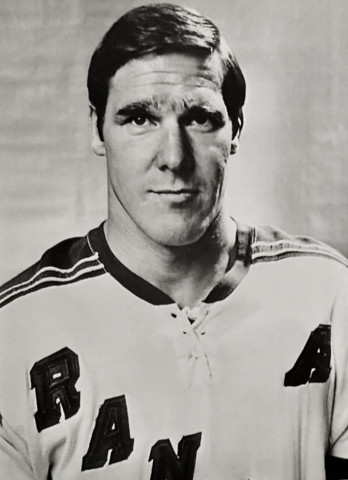
EditMiles Gilbert "Tim" Horton - Born January 12, 1930 in Cochrane, Ontario - Died February 21, 1974 in St. Catharines, Ontario was a Canadian ice Hockey defenseman.
- F. G. "Teddy" Oke Trophy Champion 1952 with Pittsburgh Hornets.
- Calder Cup Champion 1952 with Pittsburgh Hornets.
Calder Cup finalist 1951
- Stanley Cup Champion 1962, 1963, 1964, 1967 with Toronto Maple Leafs.
Stanley Cup finalist 1959, 1960.
- Prince of Wales Trophy Champion 1963 with Toronto Maple Leafs.
Horton was named Tim by his mother Ethel before he was born. His father Aaron named him Miles and Gilbert after his two grandfathers.
After playing for the Sudbury High School junior Hockey team in 1946, Horton’s friend saw a newspaper ad promoting the tryouts for the local Junior A team, the Copper Cliff Jr. Redmen of the Northern Ontario Hockey Association. He made the team for the 1946-47 season, breaking his ankle during their playoffs.
Horton had been scouted and signed by the Toronto Maple Leafs, and he received a sports scholarship with St. Michael’s College for the 1947-48 OHA season, and played 2 seasons with St. Michael’s.
The Maple Leafs sent Horton to the AHL Pittsburgh Hornets where he made his pro debut in 1949, helping them win the Calder Cup in 1952, after reaching the Calder Cup finals in 1951.
Horton made his NHL debut with Toronto Maple Leafs on March 26, 1950 vs New York Rangers at Madison Square Garden in a 5-3 Rangers win. he had a 2 minute roughing penalty.
Horton scored his 1st NHL goal vs Al Rollins of Chicago Black Hawks at 7:35 of 2nd period on October 19, 1952 at Chicago Stadium in a 3-2 Toronto win.
Horton would play for Toronto for nearly 20 full seasons, 1184 regular season NHL games and 86 NHL playoff games, helping them win 4 Stanley Cup championships.
Toronto goalie Johnny Bower called Tim Horton "Superman" for his absolute strength and not being a dirty Hockey player.
The Maple Leafs traded Horton to New York in early March 1970, where he helped the Rangers into the 1970 NHL playoffs, losing to Boston in the quarterfinals 4-2 in games. Horton played the whole next season in New York, helping them into the playoffs, where they defeated his old team the Maple Leafs 4-2 in games during quarterfinals, then lost to Chicago 4-3 in semifinals.
The Pittsburgh Penguins selected Horton in the NHL Intra-League Draft in June 1971, where he played for just 1 season. Buffalo Sabres then claimed Horton in another NHL Intra-League Draft in June 1972.
Horton played in 1445 regular season NHL games, scoring 115 goals (21 GWG), 403 assists with 1611 penalty minutes and 126 NHL playoff games, scoring 11 goals (1 GWG), 39 assists with 183 penalty minutes.
Horton played in NHL All-Star Games 1954, 1961, 1962, 1963, 1964, 1968, 1969.
Horton was selected to the NHL First All-Star Team in 1964, 1968, 1969.
Toronto Maple Leafs retired jersey number 7 on behalf of Horton and King Clancy who wore number 7 from 1930-37 on October 15, 2016.
Gordie Howe Quote
Howe called Horton “the strongest player in Hockey.”
Tim Horton was inducted (posthumously) into the Hockey Hall of Fame in 1977.
Tim Horton was inducted (posthumously) into the Buffalo Sabres Hall of Fame in 1982.
Tim Horton was inducted (posthumously) into Canada's Sports Hall of Fame in 2002.
In January 2017, Horton was part of the first group of players to be named one of the "100 Greatest NHL Players in history"
NOTE
The De Tomaso Pantera sports car that Horton was driving in when he died, had flipped several times before it came to a stop on it's roof, was given to him by Buffalo Sabres general manager Punch Imlach. Horton btw, had a blood alcohol level that was twice the legal limit when he died, and he was found 123 feet away from the Pantera, as he was not wearing a seatbelt.
Maple Leafs owner Harold Ballard ordered all flags at Maple Leaf Gardens to be lowered to half staff until after his funeral.
Horton founded “Tim Horton Donuts” in 1964, establishing the 1st location in Hamilton, Ontario. He later abbreviated to “Tim Horton’s”