
SIMILAR IMAGES


IMAGE INFORMATION
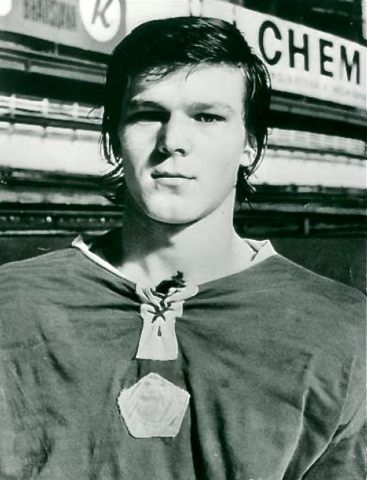
EditPeter "Peter the Great" Šťastný - Born September 18, 1956 in Bratislava, Czechoslovakia (Slovakia) is a retired Slovak-Canadian ice Hockey centre.
Šťastný (pronounced Stash-nee) played all of his minor and junior Hockey in his hometown of Bratislava, his junior team was the HC Slovan Bratislava Jr. joining the senior team (HC Slovan Bratislava) in 1975, and by his 2nd season, was scoring more than a point per game consistently. In his 198 games with Slovan Bratislava, he recorded 131 goals and 109 assists for 240 points. Like his brothers (Marián & Anton), he appeared in multiple international tournaments as a representative of Czechoslovakia: 2 World Junior Championships (1975, 1976), 1 European Junior Championship (1975), 4 World Championships (1976-79), the Olympics (1980; for Slovakia in 1994), and the 1976 Canada Cup (for Canada in 1984).
Representing Czechoslovakia, Šťastný won Gold Medals at the 1976 and 1977 World Ice Hockey championships, Silver Medals at the 1978 and 1979 World Ice Hockey championships.
Šťastný also won a Silver Medal (runner-up) at the 1976 Canada Cup. Šťastný began the Canada Cup on a fourth line with Jaroslav Pouzar and brother, Marian. Sure enough, the Czechs shut out Canada 1-0 in the round robin and lost the finals to Canada on Darryl Sittler's memorable goal, but that wasn't what Šťastný remembers best from that tournament. "It was the most exciting thing. Every game was a sellout. I was young, I was a world champion [the Czechs had won the '76 Worlds that spring]. It was the physicality of the series that was so overwhelming. And the best players in the world from all countries were there for the 1st time. It was so incredible." Šťastný had 4 assists in 7 games, and was the youngest skater in the tournament. Only Finnish goalie Markus Mattsson was younger.
NOTE
Šťastný would later become a Canadian citizen, and represent Canada at the 1984 Canada Cup, winning the Gold Medal.
At the 1980 Lake Placid Winter Olympic Games, the Šťastný brothers (3) combined to score 16 goals for the Czech team in 6 Olympic matches, with Peter finishing 2nd in scoring with 14 points.
Peter Šťastný was the Czechoslovakia Player of the Year / Zlatá hokejka (Golden Hockey Stick) in 1979-80, after recording 26 goals and 26 assists for 52 points in 41 games.
Living in Bratislava (located in the Slovak region of Czechoslovakia), the Šťastnýs were subject to the extreme oppression of communist rule. All were outspoken against it, none more so than Peter, who had an insatiable love for the west and the NHL in particular, smuggling in copies of The Hockey News whenever possible. Unsurprisingly, Peter’s public dissension angered the government, and he was given an ultimatum: be silent or don’t play. Neither option sat well with the talented centre, so he made the life-altering decision to risk everything for a chance at freedom. Anton was more than willing to join him.
There was a 4 team European Cup finals Hockey tournament in Innsbruck, Austria, in 1980. Prior to the trip to Innsbruck – on the Communist side of the Iron Curtain – Peter and Anton talked about contacting the Quebec Nordiques, the new NHL club that had drafted Anton just 1 year earlier. Peter, one of the best forwards in the world and a member of the Czechoslovakian national team since the 1976 Canada Cup, was undrafted, but he was convinced that the Nordiques would love to have them both.
During one of the first nights in Innsbruck, Peter and Anton left the Slovan hotel to find a public phone booth at the post office. Peter made sure that he had a pocketful of Austrian Schillings for the overseas call. He had written down on a small piece of paper a telephone number he had seen in an NHL media guide – area code 418 and then 529-8441, the switchboard of the Nordiques Hockey club.
Peter was the one who did the talking, and Anton nervously looked around making sure that no one was watching. From the media guide they understood that the main person with the Nordiques was someone named Marcel Aubut, and Peter asked the receptionist to connect him with the club official.
When club president Marcel Aubut was told that “someone named Peter Stastny was calling from Europe”, he immediately took the call. Peter managed to tell Aubut in broken English that he and Anton were in Austria, that they both wanted out to play in the NHL, and that it was possible to defect while they were out of Czechoslovakia. Peter followed with a question: “Do you want me and my brother to play for the Nordiques ? - We only come in pairs. But hurry, the tournament ends on August 24.”
Aubut told Peter to stay put and that he and another club official were coming to Innsbruck on the next flight. Marcel Aubut and director of player development Gilles Leger arrived in the Austrian city roughly 24 hours later (August 22), and checked in at the Europa Tyrol Hotel - 2 blocks from the Holiday Inn where the Czech team was staying. Then they let the Šťastnýs know where they were staying. On Friday night, following their game with the Finns, Peter and Anton went to the Europa Tyrol and negotiated with Aubut and Lèger for about 2½ hours. Security around the Šťastnýs wasn't tight because Marian's wife and 3 children were still back in Czechoslovakia, and it was considered unlikely that the 3 brothers would split up, or that Marian would desert his family.
They devised a plan in which, after the final game of the tournament, Anton, Peter, and Peter's pregnant wife, Darina, would escape. What remained was the little matter of escape. Aubut pleaded, begged, reasoned with them to leave that very moment, but the Stastnys wanted to stay another day and play in a game against the Soviets at Innsbruck on Sunday. It would be their last game with Marian. That complicated the issue, because the Czechoslovak team was scheduled to leave shortly after the game. Still, the brothers insisted.
Lèger drove to Vienna, booking a room for himself in the Intercontinental Hotel and a suite at the opposite end of the corridor for Aubut. On Sunday he alerted the Canadian Embassy that some Czechoslovak Hockey players would soon be needing asylum, a pronouncement that initiated a rush of buck-passing that eventually went all the way back to Winnipeg, home of Canada's Immigration Minister, Lloyd Axworthy. Axworthy flew to Toronto, called a select group of immigration officials away from their Sunday dinners and, at Toronto International Airport, in Air France's first-class passenger lounge, decided that the Vienna Embassy should help out.
Meanwhile, the Soviets were beating the Czechoslovaks 4-3. During the game Peter's wife had taken his and Anton's bags, and her own, from the Holiday Inn to a red Mercedes in a parking lot 1,000 feet away. A unnamed secret person was the driver. The game ended at about 11 p.m., and afterward Peter and Anton had a few beers with their teammates, as usual, then ate a subdued dinner. Marian knew they would be leaving.
At 12:15 a.m. they finished dinner. The team bus was to leave at 1 o'clock. Peter had said goodby to Marian, but Anton was not around, Peter was thinking the worst about Anton being caught or something. Driving around they were looking for Anton when Peter spotted him and he got in the car.
The trip to Vienna took nearly six hours. At 6 a.m. The secret driver parked the Mercedes in front of the Intercontinental, and the Šťastný brothers and Darina went up to Aubut's suite to get a little sleep. The Canadian Embassy didn't open until 8 a.m. As Lèger and Aubut were leaving the hotel to make the final arrangements with the Embassy, they recognized, and were in turn recognized by, 2 Czechoslovak security people.
Faced with determined Czechoslovakian agents, who quickly realized what was happening, the group needed the help of not only the embassy, but also the Viennese police, Minister of Defence Gilles Lamontagne, Immigration Minister Lloyd Axworthy and Hockey Canada’s Douglas Fisher.
At the Embassy a nervy lady named Mrs. Schallgruber listened calmly as Aubut and Lèger, 2 very nervous men by now, told the tale. Upon learning that the Hockey players were the Šťastnýs, Schallgruber said they had best get these boys into custody at once. They went outside, and Schallgruber noticed a car from the Czechoslovak Embassy waiting nearby. The Šťastnýs were then secretly escorted to the Canadian Embassy by 2 Austrian policemen.
Officials from the Canadian embassy whisked the group through the city streets, evading policemen and the Czech security by, among other things, driving the wrong way down one-way streets and using sidewalks to get around traffic. After a terrifying car chase, the group arrived at the airport and boarded an airplane to Amsterdam and freedom. A connecting flight brought them to Montréal. Peter’s daughter, Katarina, would be born in Canada (the 1st Šťastný to be a Canadian citizen).
It was now late August and the Nordiques would start their training camp soon for the start of the 1980-81 NHL season. The transition to NHL Hockey was not going to be easy for Peter and his brother Anton, but that would change later in their 1st year in Quebec.
The Nordiques started their season on the road, playing 9 games away from the Colisèe in Quebec City, and Peter made his NHL debut on October 9, 1980 vs Calgary Flames at Stampede Corral in a 5-5 tie.
It took awhile, but Peter finally got his 1st NHL goal vs Tony Esposito of Chicago Black Hawks at 3:34 of 2nd period on October 26, 1980 at Chicago Stadium in a 7-4 Black Hawks win. He had 3 points in the game.
The Nordiques finally played their 1st game on home ice October 29th vs the Vancouver Canucks to a sold out home opener. Both Peter and Anton received a thunderous welcome when they were introduced to the Hockey mad Quebecers at the Colisèe.
Peter would not make the home crowd wait too long, as he scored his 1st goal at the Colisèe 13:15 of the 1st period, lifting the puck over Canucks goalie Richard Brodeur. The score would end in a 3-3 tie.
The Nordiques were in their 2nd NHL season after the WHL merged with the NHL, and were off to a awful start, winning just 1 game in their first 15 games, and found themselves a season high 14 games under .500 with an 11-26-12 record after 49 games. Quebec would then get red hot, posting a record of 19-6-6 in their remaining 31 games to finish the season at 30-32-18, earning 78 points, and their 1st ever berth into the NHL playoffs. The Šťastný brothers would also find their 2nd wind, with Peter scoring 39 goals, 70 assists during the regular season, and 2 goals, 8 assists in the playoffs.
Šťastný would become the 1st player in NHL history to collect over 100 points in rookie year (109), and recorded his 100th NHL point with an assist on March 29, 1981 against the Montreal Canadiens. He was the 1st official NHL rookie to accomplish the feat, while also being voted as the 1981 Calder Memorial Trophy winner.
The Šťastnýs represented a watershed moment in professional Hockey as one of the 1st major stars of Eastern bloc Hockey to join the NHL. The following year, his brother, Marián, joined them and they became the 3rd trio of brothers to play on the same professional Hockey team (the 1st being the Bentley brothers of the Chicago Blackhawks in the 1940s and the 2nd being the Plager brothers of the St. Louis Blues in the 1970s).
According to Peter, his defection "was the best decision I ever made. It has given my family the choices and options that people behind the Iron Curtain could only dream of. Then, to play pro Hockey with my two brothers was like icing on the cake."
While Peter and Anton were the 1st players from Czechoslovakia to play in the NHL, they would not be the last. In fact, the Šťastný brothers’ defection eventually prompted a relationship between the NHL and the Czechoslovak Ice Hockey Federation in which the two organizations negotiated the transfer of players to North America. The Šťastnýs also ignited an exodus of sorts with their bold escape as other Eastern Bloc players made their way west. Once communism finally fell, the gates to North America crashed opened for players from across Eastern Europe, ushering into North American Hockey a new breed of player and changing the landscape of the NHL forever.
Šťastný topped the 100-point plateau in his 1st 6 seasons (1 of 7 players in NHL history) adding another during a 15 year NHL career that also included seasons with New Jersey and St. Louis. His best season was his sophomore year (1981-82) when he scored 46 goals and 93 assists for 139 points.
Šťastný helped make the Nordiques a powerhouse in the NHL's Wales Conference. Many great regular season and playoff battles occurred with the provincial rival Montreal Canadiens in one of the greatest and unfortunately shortest rivalries the league has ever seen. Despite some great runs, Šťastný and the Nordiques never did make an appearance in the Stanley Cup finals. Lack of depth and great goaltending was always the weakness of the Nordiques in their tough playoff battles in the old Adams Division and Wales Conference.
In the spring of 1984 Peter Šťastný became a Canadian citizen, thus making him available for Team Canada in the 1984 Canada Cup tournament, and became the 1st ever European born and trained player to represent a Canadian National Hockey team. He was extremely proud of his Canadian citizenship but admitted that he had a Slovakian heart in the Team Canada jersey. In the game against his old teammates from Czechoslovakia, Šťastný scored his only goal of the tournament, and all his Canadian teammates jumped off the bench to congratulate him.
Šťastný was named captain of the Quebec Nordiques from 1985-86 to 1989-90, his point totals in the 1980's were topped only by Wayne Gretzky.
Šťastný recorded his 1,000th NHL point on 19 October 1989 with a goal against the Chicago Blackhawks, and was the 2nd European-born player, and 1st trained in Europe, in NHL history to do so. Stan Mikita, the 1st European-born player to score 1,000 points, was born in Slovakia, but raised in Canada.
Šťastný played in 977 regular season NHL games, scoring 450 goals (54 GWG / 2 OTG), 789 assists with 824 penalty minutes and 93 NHL playoff games, scoring 33 goals (8 GWG / 3 OTG), 72 assists with 125 penalty minutes.
Upon his retirement, Šťastný was the highest-scoring European-born and trained player in NHL history (since surpassed) and the 1st 1,000 point man.
Šťastný played in the NHL All-Star Games 1981, 1982, 1983, 1984, 1986, 1988.
Šťastný later was able to join the Slovakian National Team prior to the 1993-94 season for an Olympic Qualification Tournament in Sheffield, England. He rejoined the team as a member of Slovan Bratislava in early November to play at Telehockeycup in Norway. He was the flag bearer for Slovakia and played at the 1994 Lillehammer Olympics, finishing 2nd in the Lillehammer scoring race, which he also did 14 years earlier in Lake Placid
Šťastný also played in the 1995 World Championship (Pool B) as a member of the Slovakian National Hockey Team, and helped Slovakia gain A-Pool status as he led all the scorers in the B-Pool World Championships.
- Shares NHL record for assists by a rookie (70) with Joé Juneau.
- Holds NHL record for points in a game by a rookie with 8 (4 goals and 4 assists on 22 February 1981 against Washington Capitals).
- Holds NHL record for points in a road game with 8 (4 goals and 4 assists on 22 February 1981 against Washington Capitals).
- Holds NHL record for points in 2 consecutive games with 14 (3 goals and 3 assists on 20 February 1981 against Vancouver Canucks and 4 goals and 4 assists on 22 February 1981 against Washington Capitals)
Peter Šťastný was inducted into Hockey Hall of Fame in 1998.
Peter Šťastný was inducted into IIHF Hall of Fame in 2000.
Peter Šťastný was inducted into Slovak Hockey Hall of Fame in 2002 – but he voluntarily quit and had his trophies retrieved as a form of protest against Juraj Široký (President of Slovak Ice Hockey Federation).
Peter Šťastný was inducted into Czech Ice Hockey Hall of Fame in 2010.
From 2004 to 2014, Peter Šťastný served as a Member of the European Parliament for Slovakia (Slovenská demokratická a kresťanská únia – Demokratická strana SDKÚ-DS).
In 2017, Peter Šťastný was named one of the '100 Greatest NHL Players' in history.
The Peter Šťastný family (Peter, Yan & Paul) is the 1st Hockey family known to have represented four different countries in international play (Czechoslovakia, Canada, Slovakia, USA).